Thursday, 2 August 2012

Historic Pilbara Towns


The caravan park we stayed in at Port Samson was probably the best we have stayed in - large sites, modern roomy amenities and walks to the beach, port and town centre ( a park, shop and tavern). It was probably what we hoped Broome would have been. Unfortunately only 3 nights were available.

Morning church at the Wickham Anglican Church  was interesting. Held in the Community Hall the Service featured the presentation of Club Colours to two local members of the Saints Motor Cycle Club by the club President who was visiting from Brisbane. He also gave the message. The service lasted two hours, which was a bit too long, but was obviously very significant for the people involved and for the Wickham congregation. The Saints members in Queensland see their ministry as reaching out to the outlaw clubs, which is a big challenge, and the local chapter, which includes members from Roebourne, intend to minister to prisoners in the Roebourne Regional Prison.

Over the next few days we explored several Historic towns.

Roebourne was the first town in northern Western Australia. On the banks of the Harding River, many of the old buildings are on the North West Coastal Highway and are still in use. It was a major centre from the late 1800's and until the 1960's was the centre of a huge sheep industry.  In a book I read about the Karratha Sheep Station, Roebourne features prominently as the centre for shopping, regional meetings and social events, such as the Roebourne Races. In the 1950's, Race week  included a Ball, cricket games, perhaps a gymkana and of course two days of racing. It was actually Roebourne Cup day the day we arrived. We enjoyed the museum in the old Gaol, two aboriginal  art centres (didn't buy anything - the ones we really liked cost over $5,000.00 - we have good taste!), driving around the streets, the view from a lookout  and a Classic Magnum - special treat because I had been good. Roebourne seems to be growing, probably because of the major expansion of nearby Cape Lambert by Rio Tinto. Small blocks at a new subdivision were on the market for between 2 and 3  hundred thousand dollars.


At the mouth of the Harding River is Cossack, originally the port for Roebourne. The two towns were connected by a horse drawn tramway - later a small steam engine replaced the horses. Goods and passengers were shipped from Fremantle, there were virtually no roads, and wool was the main export. Over time as the ships got bigger and also because the river silted up, the Port was shifted to Point Samson, where we stayed. Most of the buildings fell into disrepair but a group of enthusiasts, assisted by prisoners from Roebourne Gaol, have restored several of the significant buildings and the whole area is now an historic site. The afternoon we visited there was an art show in the Bond Store with some great art work.

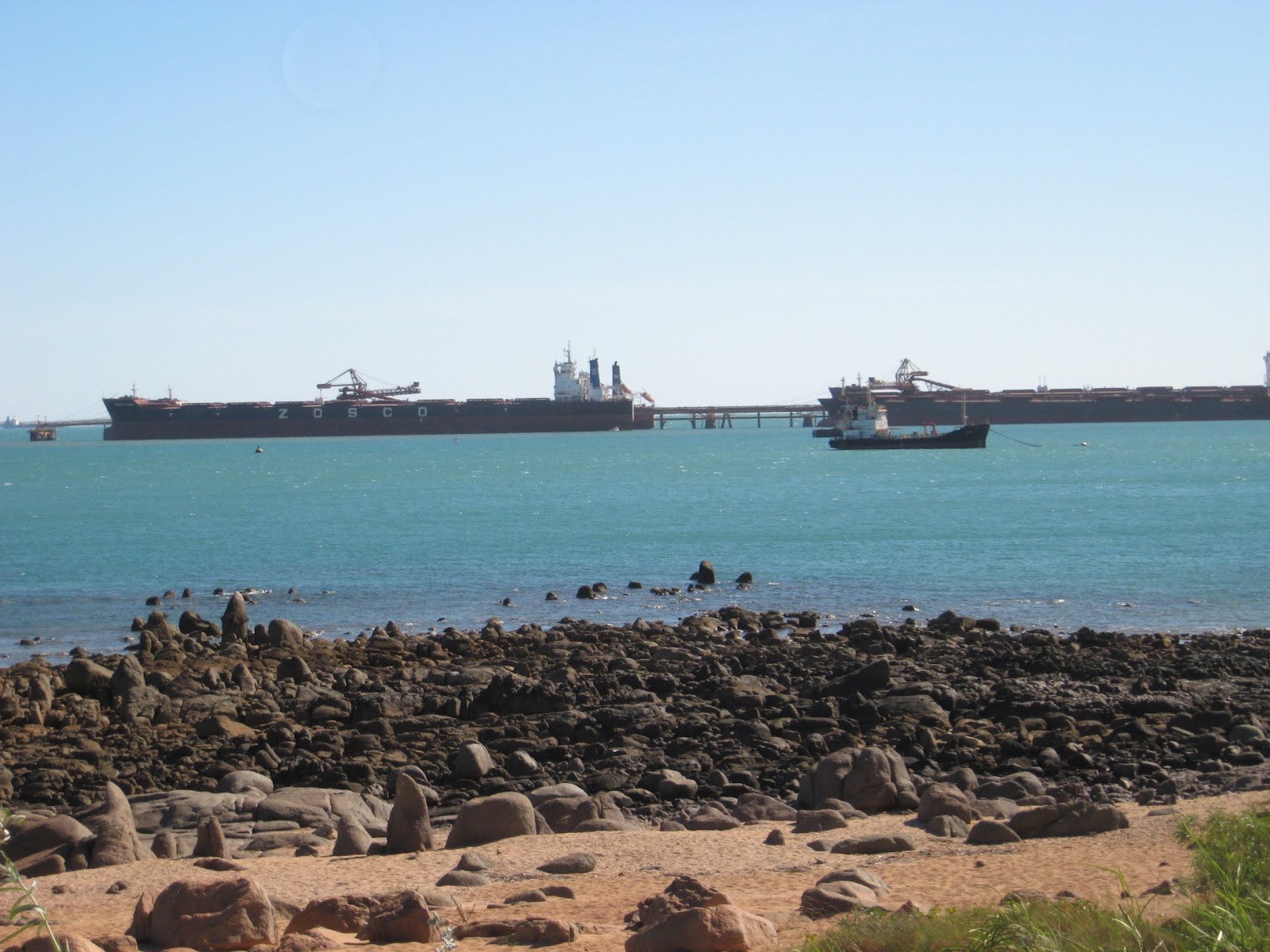
Between Roubourne and Point Samson is Wickham. Not an historic town but still quite interesting. Wickham is a company town built for employees of Rio Tinto who work at Cape Lambert where trains bring iron ore from Tom Price or Parabadoo for shipment to Asian Ports. The Port can handle 4 ships at a time. It takes 24 to 36 hours to fill a ship using extremely long conveyor belts. The Port facility is being expanded and the railway line duplicated so that handling capacity can be doubled. Consequently, 200 new homes are being built in Wickham, Rio are spending $250 million on redeveloping the town centre, a camp for 5,000 FIFO's is to be built and it seems a new gas fired power station is also almost finished. All mind blowing stuff to us simple country folk.  A worker we talked to at a lookout told us that he earned about $3,500 per week. Near our caravan park in Point Samson, the harbour was the base for the Cape Lambert tugs and we took great interest in their comings and goings.


Our third historic town was Onslow, two days later and 400km down the coast. Onslow is small at the moment (about 800 people) but humming with company 4WD's and mini buses. The caravan park was 80% accommodation for people wearing high vis clothing, because, 30km away there is going to be another huge natural gas project, new Port, processing plants ect. etc. A camp is being constructed for 500 workers who will build a camp for 6,000 FIFO's who will build everything else. The Wheatstone Project by Chevron  is going to cost billions. Time to buy some investment land in Onslow!


We are badly in need of a National Park fix which hopefully we will get at Cape Range N.P., although apparently it is hard to get in. We will need to be at the Rangers by 7.00am and the number allowed in will depend on the numbers leaving. I wish some of the grey nomads would go home!


Saturday, 28 July 2012

Pilbara - Mountains to the Coast


From Tom Price - highest town in W.A., (where we had about 1mm of rain overnight),  we called into Hammersley Gorge on the edge of Kurijini N.P.- the most interesting rock formations and colours we have seen, a waterfall over very large rocks into a beautiful, quiet, still poool of green clear water and tinyfish.
 Another 40km or so on sometimes very rough and dusty roads brought us to Mt Florence Station for lunch. The grassy site was very welcome and we sat under a tree reading books and watching birds. The station workers returned late in the day from mustering 600 cattle into a yard 30 km from the homestead. They came by battered utes, motorbikes and a helicopter. The camp park is surrounded by spinifex plains, but some big trees in the camp ground.


Despite all of our covering of vents there was  still a lot of dust in the van when we arrived at Millstream-Chinchester N.P. next day. This park is a real oasis in a semi arid environment. The Fortescue river has a wide bed which is fed by the Millstream which is filled from springs from an underground aquifer. The Parks Visitor Centre is the old homestead and much of the old garden of palms is still to be seen. The Millstream pool is beautiful with plants growing under the water, lily plants on the top and small fish easily seen in the clearest water we have ever seen.


After a second lovely and lazy day in Millstream (including a 6km walk) we travelled over some terribly rough road toward Karratha, finally reaching bitumen with 100km to go. We travelled through some interesting country - small hills with exposed dark brown rocks tumbling down the side, looking like humans have dumped truck loads of unwanted rocks. Everywhere there was evidence of the mining industry. Railway lines (we saw 3 trains), new lines being built - work camps everywhere, powerlines criss- crossing over the hills, road trains, and of course the 4WD,s complete with flags and security codes on the side - we think we will put a sticker on our car - MBGNSAVAN  - that will make them think!


Two days in the Karratha / Dampier area saw us doing domestic things including trying to clean the inside of the van and washing the car. We also enjoyed learning about the area. As well as a major port for Rio Tinto - it's where all the trains come, it is also the base of the North West Shelf Gas Project. The extent of this project amazed us and the excellent visitor centre gave us plenty of information to absorb. An off shoot industry uses the natural gas to produce hydrogen and then liquid ammonia via the Haber process - for all those chemists out there. Dampier and all of the industry is on the Burrup Peninsula where very significant ancient rock art exists in sight of towers flaring gas. Karratha is the well planned dormitory town for the workers and is quite a pleasant place, nice parks, good schools and public buildings and a large shopping centre.

It was interesting to read in the local paper that the Dampier community, closely followed by the Karratha community, is the richest community in Australia. Over one quarter of the families have a weekly income over $4,000. Mind you house rentals are around $2,000 per week. It must be hard for a single shop assistant to live in these towns. Also, it seems as though the number of fly in fly out (FIFOS) workers is increasing as this is most economical system for the larger industries.
It was also interesting to learn that one of the Rio Tinto iron ore mines is now using driverless trucks. I don't know how it works but I hope they don't have too many computer gliches - those trucks cost about 6 million dollars each.
You can see we are learning heaps! Over the next 3 days we will be exploring the historic Point Samson, Roebourne and Cossack regions.


Friday, 27 July 2012

House Update

Finally the rain has eased off, what a wet Winter it has been in Victoria. Consequently the block has dried off enough for the garage slab to be poured - about 5 weeks later than we had hoped for - poor Toph. But it's done and it looks good.


Looking at the photo has made us a litle bit home-sick, although we don't really have a home at the moment. We have been living in the Avan for 6 months now and despite the fact that the curtains are filthy, the door lock is broken, the stove is being held in place by 2 screws instead of 4, and outside it is a red instead of white colour, we are still travelling well and enjoying seeing this vaste country and learning new things.

Sunday, 22 July 2012

The Pilbara


The Pilbara - if you think 'mining boom', 'colourful gorges', 'open spaces', you are correct, all of those things on a large scale.
On advice from locals in Marble Bar about road conditions we did not take route 138, the most direct road to Newman. Instead we took a fairly direct unsealed road to the Gt Northern Highway. 140km of good gravel road, no traffic, passing through undulating then flat country. Plenty of spinifex, trees in the river beds, interesting piles of rocks that looked as they had been stockpiled rather than natural. A very enjoyable trip under clear blue skies.


Near the end of this road there was a railway crossing with a train stretching out of sight in either direction. We had arrived in 'mining country'.

Boy, had we arrived. As we travelled down the Gt Northern Hwy, there was road train after road train. Some carrying ore, some fuel, some equipment, some massive tyres. I have never seen so many escort vehicles moving on-coming traffic over to the left as another oversize load went past. There were also heaps of dirty utes and 4WDs, each emblazoned with a large security identification code. The most amazing sight was equipment, at least 3 storeys high on a massive trailer with hundreds of wheels, pulled by two linked prime movers. Two of these  were in a rest area at the top of a rise and unfortunately we could not stop for a photo. The road would have had to be closed to other traffic when they were moving.


After reaching Newman we were able to make contact with Tristan and Catherine Cole, whom we first knew at Frankston when they were young children. Catherine's parents, Gary and Joy Scott, were visiting them and on Sunday we were able to have lunch with them all after sharing in worship at the Baptist Church. We were enthralled with Tristan's stories of his work He is employed by an Indigenous Community, funded by an NGO to preserve cultural and significant sites of the Martu people living in a number of communities on the edges of the Great Sandy Desert. His work has seen him travelling with an aboriginal elder while he sings a song taught to him by his grand father when he was a boy. The man had not been to the area before because the Martu were removed from the desert in the 1960's but through the song he was able to direct Tristan as he drove, leaving the track and going cross country, then leaving the vehicle and walking up a dry creek bed until finally reaching a fresh water spring, just where the song taught to him as a boy told him it would be. Tristan records the position of the site, it's condition and any preservation required. He manages a team of aboriginal rangers who are responsible for doing this work and often has to fly to Perth to report to the Board. He is very busy but obviously loves the work and receives great support from Catherine. Many of his stories about his experiences were very funny.

On Monday we did a tour of the Mt Whaleback Mine, a BHP Billiton mine and the largest open-cut mine in the world. Amazing to see the the size of the operation - massive trucks (60 of them, each of which uses 4,500L of diesel a day), conveyor belts, treatment plants, trains which don't stop - they move at 2km/hr beneath a hopper which fills each of the 323 trucks as they move through, before travelling the 8 hrs to Port Hedland on the longest privately owned railway in the world, where they dump their loads, once again without stopping. 


The next four days saw us in the wonderful Karijini N.P. - the main features are the deep, colourful gorges which you reach by walking down steep steps or climbing down ladders. At the bottom are pools of deep green water, huge paperbark trees, fern gardens, waterfalls, - we did lots of rock hopping but stopped when required to wade through freezing cold pools. Lookouts from the tops of the gorges gave some amazing views.


Unfortunately, I suffered with a tummy bug for one day which also slowed me done a bit for the next couple of days.

 We travelled on to Tom Price, another mining town but smaller than Newman and greener and neater. We are almost sick of the red dust, everything has a dark red sheen. The van and car, both inside and out, our clothes, the buildings in town, trees by the roadside, even the birds - the corellas in the park need a good wash. From here, after doing loads of washing and cleaning, we plan to travel to the Millstream - Chinchester N.P. and then back to the coast.


Mt Bruce, second highest mountain in W.A.


Friday, 13 July 2012

Hottest Aussie Town in the World's Largest Shire

Where are they? You may well ask. Marble Bar of course.

Port Hedland - Marble Bar 200km

On almost the spur of the moment we decided to back track up the highway for 50 km, then turn off  and visit Marble Bar. The 'Big News' was that it was cloudy and looked like rain as we left Port Hedland. As it turned out there was a very slight drizzle for about 10 minutess and then it was sunny again. We enjoyed the drive to the Des Streckfuss rest area, a free roadside stop next to a waterhole. We sat in the sun for the afternoon, watching birds, reading and listening to passing road trains. We were amazed by the number of trucks carrying ore from inland mines to Port Hedland. They did go all night but we were a fair way from the road and Merilyn wasn't troubled by the noise. We shared a campfire and nice chat with a couple from Seymour. Next day as we approached Marble Bar we passed through some very attractive hills. Marble Bar is in the Guiness Book of Records as Australia's Hottest Town because in the Summer of 1924, for 161consecutive days leading up to 20 April, the temperature never dropped below 37.8 degrees C. That is Hot! Today, mid-winter, it was a cool 28 degrees - real nice! A man we chatted with in town who was visiting his 80 year old mother who won't ever leave the place, said that summers are unbearable. It is a very small town, but is in the largest Shire in the World - from the Indian Ocean high water mark to the Northern Territory Border.We enjoyed an historic walk around part of the town with some fine views from a lookout.


'. These two pictures are looking up the main street at 3 o'clock on Thursday afternoon. One shows the historic 'Iron Clad Pub' and the other the General Store/Post Office/Roadhouse. A young aboriginal boy had just come out of the store and was kicking a football across the road. It's not much bigger than Pomonal!
Can you spot the Bertram's A van?

Today (Friday) we completed the historic walk in the morning and after an early lunch drove to historic Comet Mine - a gold mine - where there was an interesting museum. On the way back we fossicked for Jaspar, took in the view at Flying Fox Lookout, recorded 19 species of birds at Chinaman Pool, and marvelled at the Jaspar that the original settlers thought was marble - hence the town's name. Altogether another very good day - no clouds again but a fairly cool breeze.

Tuesday, 10 July 2012

Not so happy in Broome

Broome - Port Hedland  approx 600km


Our week in Broome was not quite what we expected. Everyone we met on the road said we must book at Broome or we would never get in. So, a couple of weeks ago I got on the phone and managed to get a park, Vacation Village, that could fit us in for a week. Thank goodness! It sounded OK - on the Port Road, a bit out of town, opposite the Golf Course. We were really looking forward to a week under the palm trees, relaxing next to the pool, riding to Cable Beach, lattes in China Town etc. a real tropical holiday!  The reality was that, although it wasn't a bad park, our site was hard against a wire fence which was about 8m from the Port Road which was probably the busiest road in Broome. Heavy traffic, including trucks, road trains, 4WDs, workers utes, motor bikes, started at 5.00 am and continued until 10.00pm and then quietened down a bit but still went all night. As well as the road to the port it also serviced the major light industry area in Broome. At times we had to shout to be heard. Several  people camped near us left early and lost their money ($45p/n)  - there were no refunds. It was not a restful place.


Our first two days were taken up with food shopping, trying to get my camera fixed (couldn't), trying to get the computer fixed - couldn't, ended up buying a new one - doing 3 loads of washing, and trying to catch up on some sleep - almost impossible. On the Friday we felt ready to explore Broome and just before we were about to leave Merilyn felt something 'go' in her back as she lifted the bed. The next 2 days for her were spent on the bed in agony.  The constant pain could only be eased by lying in a certain position. On Monday we got an appointment with a young physiotherapist who was able to manipulate her pelvis back into its correct position, and with deep massage and exercises the pain eased and after a couple of days she is now quite recovered. 
 
 I did manage to do some good rides around Broome, covering both sides of the Peninsula.

I had a good time on the Sunday afternoon when I visited the famous, and quite lovely, Cable Beach. I took the classic photo of the camels on the beach with palm trees in the background and then turned and took a photo of what you don't see in the promotion pictures - dozens of 4WD's parked on the beach so their occupants can swim or just look at the view. This is what the rich tourists pay to walk past on their camel ride!


As I walked from this part of the beach I counted 30 4WD's in a line waiting to get off the beach up the narrow winding track down which 20 or so vehicles were still coming on to the beach. It took about 20 minutes for the congestion to clear. All good fun at the beach on a Sunday. In fairness the main swimming area is separate from this part of the beach. The sand is white, clean, very wide at low tide, and you can lounge on it under an umbrella for only $30 a couple for half a day - how good is that!


When Merilyn was feeling better we did enjoy exploring China Town and learning about the Pearling industry - we also had some nice coffee. Unfortunately we were not able to book a tour we had planned for Cape Levique - fortunately as it turned out because Merilyn would not have been able to go. We left Broome with good feelings about the place but somewhat disappoined and far from relaxed.
Our next stop was at Port Smith, only 130km down the road, and this was a great place. Huge shady sites, quiet - we could hear the birds, with a lagoon which was just lovely. At high tide the water was clear and blue and at low tide you could walk, or drive, across the sand for 100's of metres - it was truly amazing. One day the park owner took us across the lagoon at high tide (gold coin donation to the Flying Doctor) and left us for 4 hours. We were able to walk to the Indian Ocean, wading through a shallow inlet on the way, and we were the only ones there, Awesome!
After 3 days we were feeling relaxed. Next stop was at Eighty Mile Beach, a couple of hundred kms down the road where we spent 3 nights. Very much a fishing place but also a lovely beach to walk along - we did 3 good walks and lots of reading, resting and chatting with neighbours. I only found out as we were leaving this morning that camped behind us, with his wife and two children, was Alex Julicher, a student of mine from Woodleigh. He now drives a tug on Darwin Harbour. We had a nice but brief chat.
  
This is high tide. When the tide is out the beach is almost 1km wide.

Today we have come on another couple of hundred kms to Port Hedland where we have done a good 20km bike ride. The Port is quite amazing with 3 km long trains bringing ore from inland mines to be shipped overseas. We counted over 25 ships waiting out at sea. There were at least 5 being loaded. Ten tugboats were at the dock, road trains were loading up from huge tanks to take fuel to the mines. There are cars with yellow lights on top, flags and large numbers on the sides everywhere, and almost everybody wears a flouro work jacket. A real industrial city. As we prepare for bed we can hear trains being shunted - they each have two locos in the front, two in the middle, and 232 trucks. From outside the van the horizen is a  mass of bright lights. We are only here for one night - it is school holidays and everything is booked. Tomorrow we might head inland to Marble Bar - why not!