Thursday, 23 August 2012

Inland Circuit

Our journeying over the last week and a bit has seen us staying at 4 stations, a roadhouse, another lovely  National Park, and a coastal holiday town. Much of it we shared with friends Anne and Roger from Tasmania. We managed to fill the van with a lot of red dust!

Quobba Station - North of Carnarvon the plains and red sand dunes go on and on and then stop abruptly at the coast with its rocky shelf and spectacular waves. On the way to the station we admired a spectacular blowhole and then set up camp just over the first sand dune. In the afternoon we drove further up the coast - more huge waves breaking over huge rock shelves and also a stockpile of Rio Tinto salt from nearby Lake Macleod ready for shipment overseas. We also visited a lonely memorial to the seamen who died on H.M.A.S. Sydney in WWII. The Sydney was sunk by the German raider Kormoran off the W.A. coast and all hands were lost. The Kormoran also sank and the survivors came ashore near Quobba Station.


Bidgemia Station - East of Carnarvon, 11km further on from Gascoyne Junction. Anne and Roger arrived just as we started lunch, they had come from Mt Augustus. Our camp was next to the Shearers Quarters overlooking the Gascoyne River bed and we made good use of the Camp Kitchen. We walked West along the river bed before afternoon tea and East afterwards. The river bed is about 600m wide in places and two years ago, after a cyclone, the river flooded and rose halfway up the walls of buildings. The owners retreated to the top of a water tank and were rescued by helicopter next day. The station was pretty and tidy and they have almost recovered from the flood.


Kennedy Range N.P. -  60km north of Gascoyne Junction. Very remote, arid country with wonderful gorges. On top of the range the country is undulating with red sand dunes. Hardly any visitors and not many birds - spectacular and silent. Over our 3 day stay we hiked into 3 gorges, climbed to the top of the range, rose early for a sunrise from a lookout AND found the nesting site of some Dawson Burrowing Bees. These are Australia's largest bees and nest in individual holes in the ground. We had seen a video about them whilst in Carnarvon and Anne and Roger had found out about them at Mt Augustus on the same day! We were very excited to find their nesting site (Roger had been given information on where to look by a Ranger at Mt Augustus) and we were glad they didn't sting because they were very big. It was very interesting to watch these big bees pop in and out of the holes where they lay cocoons filled with honey. The indigenous people cook the grubs still in their mud cases as a delicacy. All of the gorges were impressive but Honeycomb Gorge was so interesting with it's sculptured walls. The temperature was over 30 degrees C every day.


Murchison Roadhouse -  About 360 km from the Kennedy Ranges. Dirt roads all the way, many interesting stops, only saw 3 other vehicles, travelled from the Gascoyne Region into the Murchison Region and below the 26th parallel - officially out of the North West. When we pulled into Murchison Roadhouse we decided to stay because the grass was green, the showers hot, we could go out for dinner (no cooking or washing dishes) and we could have a latte after visiting the local museum next morning. A real oasis.
Merilyn Driving
 
Old well on stock route

 
Wooleen Station - only 50 km east of Murchison. We were welcomed by Frances and the dog 'Poppy' a kelpie who loved to chase sticks and golf balls. Frances and her husband David have featured twice on 'Australian Story' over the last 18 months. They are making great efforts improve the condition of the de-graded land , whilst still keeping it as a working cattle station. Tourism has become am important part of their business. After setting up and having lunch, armed with a mud map, we took ourselves to two pools along the Murchison River where we were able to see some good birds. Back to camp for afternoon tea, a walk around the Station Museum and off again with the mud map across a dry lake bed and to a spot where we could watch the sunset.


The next Station was Hamelin Station, Hamelin Telegraph Station ...


Monday, 13 August 2012

Wonderful Cape Range N.P.

First stop after Onslow was Exmouth - a relaxed holiday town. No high vis jackets, utes with flags, big trucks etc. but plenty of vans, motor homes, grey nomads and backpackers. Some nice homes being built on a large marina estate - blocks between $350,000 and $450,000, several new resorts, many businesses associated with diving, game fishing, boats chasing whales and a fairly busy port with huge prawn trawlers and large tenders which service the off shore oil and gas rigs.  Also very evident are the huge masts of the Harold Holt Communication Centre - the central mast, one of 13, is the second highest structure in the Southern Hemisphere. They communicate with navy ships, navy bases and submarines around the world and also of course with Canberra . We enjoyed our two days exploring the area, despite probably being in a nuclear target zone.


Then it was time to try and get into Cape Range National Park, which is on the western side of  North West Cape . Enquiries at the Information Centre informed us that we needed to line up at the Ranger's Office at about 7.00am and the Ranger would allocate sites at 8.15am when he/she knew the number of vacancies - there had been only 10 vacancies that day. We were also told that if we arrived much before 7.00am we could be fined for illegal camping. So next morning we were up at 5.30am and out at the offfice at exactly 7.00am to find ourselves 10th in line! We popped the van up and had breakfast and waited anxiously.  At 8.15am a Ranger slowly moved down the  line of cars, we prepared ourselves to be turned away, but he got to us and said there were 14 vacancies that day. We were in!! We were allocated a site in Ned's Camp, the first camp  in the park, and it was just lovely. Our site, one of 15, was fairly sheltered and only about 30 metres from a pristine beach. The surf was spectacularly breaking over Ningaloo Reef, about 500m off shore, and the lagoon was turquoise blue and calm. From our van we had a good view across the car park to the sea. Camp Hosts Steve and Kerry were very welcoming and it wasn't long before we were meeting neighbouring campers. We only booked for 2 days but kept extending and stayed for 8. We walked on beaches, up gorges, along ridge tops and around a mangrove lagoon. A 2 hour trip on a glass bottom boat was lovely and also allowed us to snorkel over the coral reef. Happy Hour at 5.30pm each day enabled us to chat with other campers, some of whom came every year and stayed for the maximum 28 days. We met some lovely people. From a hill near the lighthouse ( where we went to make phone calls) we could watch humback whales on their annual migration to breeding grounds up the coast. We were given some lovely fish for tea one night - the fishermen in camp caught fish every day from their small boats or canoes, although sometimes they lost their fish to sharks. The whole experience was a lovely holiday within the holiday. We would like to come back.


We were a bit sad to leave but ready to move on. Carnarvon is quite a lovely place. Lot's of plantations, orchards and vegetable gardens. We are eating good tropical fruits and lovely fresh vegetables. Soon we are to catch up with our friends Roger and Anne in the Kennedy Range N.P., inland from Carnarvon - back to red dust and rocky roads.

Thursday, 2 August 2012

Historic Pilbara Towns


The caravan park we stayed in at Port Samson was probably the best we have stayed in - large sites, modern roomy amenities and walks to the beach, port and town centre ( a park, shop and tavern). It was probably what we hoped Broome would have been. Unfortunately only 3 nights were available.

Morning church at the Wickham Anglican Church  was interesting. Held in the Community Hall the Service featured the presentation of Club Colours to two local members of the Saints Motor Cycle Club by the club President who was visiting from Brisbane. He also gave the message. The service lasted two hours, which was a bit too long, but was obviously very significant for the people involved and for the Wickham congregation. The Saints members in Queensland see their ministry as reaching out to the outlaw clubs, which is a big challenge, and the local chapter, which includes members from Roebourne, intend to minister to prisoners in the Roebourne Regional Prison.

Over the next few days we explored several Historic towns.

Roebourne was the first town in northern Western Australia. On the banks of the Harding River, many of the old buildings are on the North West Coastal Highway and are still in use. It was a major centre from the late 1800's and until the 1960's was the centre of a huge sheep industry.  In a book I read about the Karratha Sheep Station, Roebourne features prominently as the centre for shopping, regional meetings and social events, such as the Roebourne Races. In the 1950's, Race week  included a Ball, cricket games, perhaps a gymkana and of course two days of racing. It was actually Roebourne Cup day the day we arrived. We enjoyed the museum in the old Gaol, two aboriginal  art centres (didn't buy anything - the ones we really liked cost over $5,000.00 - we have good taste!), driving around the streets, the view from a lookout  and a Classic Magnum - special treat because I had been good. Roebourne seems to be growing, probably because of the major expansion of nearby Cape Lambert by Rio Tinto. Small blocks at a new subdivision were on the market for between 2 and 3  hundred thousand dollars.


At the mouth of the Harding River is Cossack, originally the port for Roebourne. The two towns were connected by a horse drawn tramway - later a small steam engine replaced the horses. Goods and passengers were shipped from Fremantle, there were virtually no roads, and wool was the main export. Over time as the ships got bigger and also because the river silted up, the Port was shifted to Point Samson, where we stayed. Most of the buildings fell into disrepair but a group of enthusiasts, assisted by prisoners from Roebourne Gaol, have restored several of the significant buildings and the whole area is now an historic site. The afternoon we visited there was an art show in the Bond Store with some great art work.

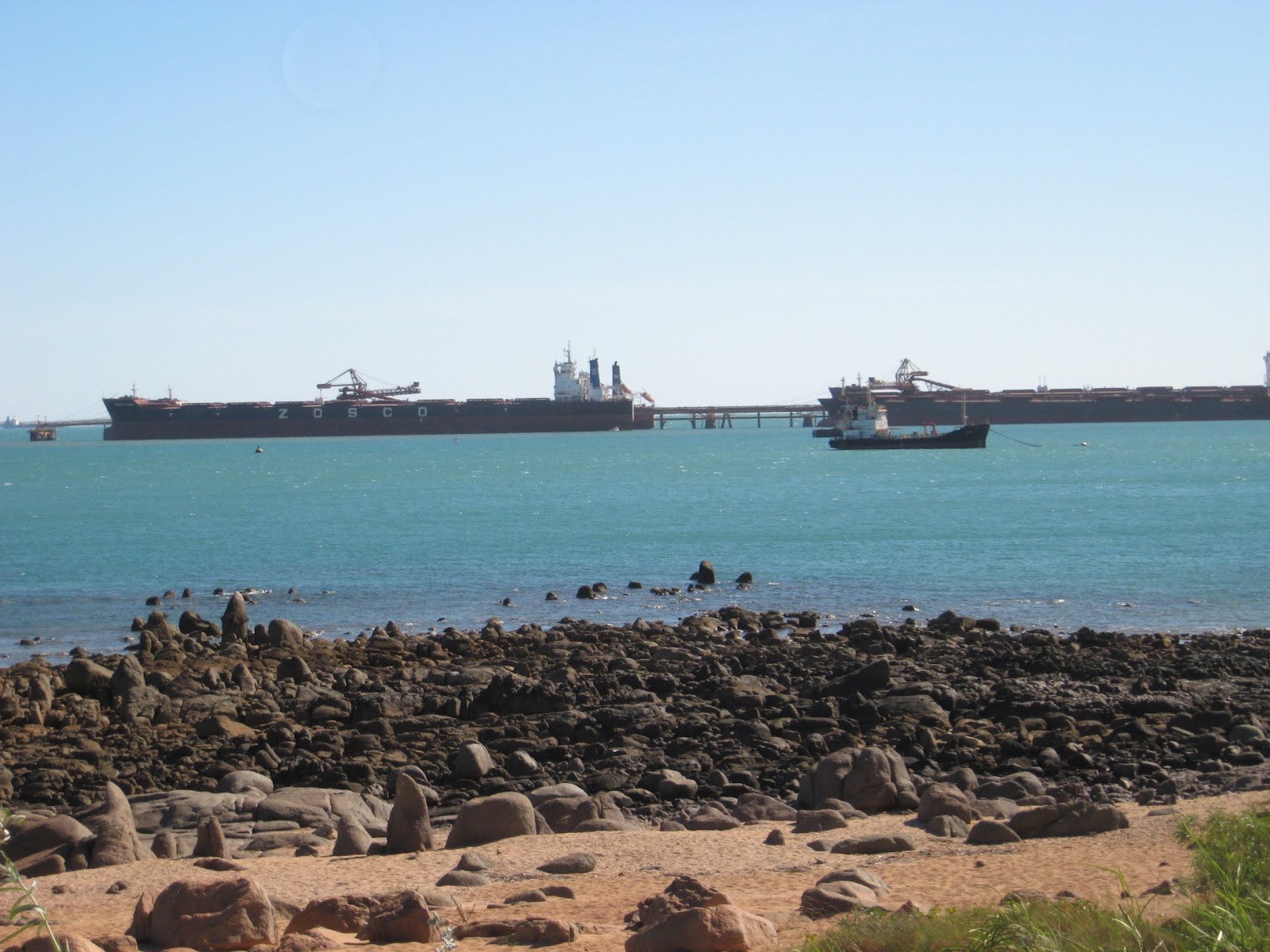
Between Roubourne and Point Samson is Wickham. Not an historic town but still quite interesting. Wickham is a company town built for employees of Rio Tinto who work at Cape Lambert where trains bring iron ore from Tom Price or Parabadoo for shipment to Asian Ports. The Port can handle 4 ships at a time. It takes 24 to 36 hours to fill a ship using extremely long conveyor belts. The Port facility is being expanded and the railway line duplicated so that handling capacity can be doubled. Consequently, 200 new homes are being built in Wickham, Rio are spending $250 million on redeveloping the town centre, a camp for 5,000 FIFO's is to be built and it seems a new gas fired power station is also almost finished. All mind blowing stuff to us simple country folk.  A worker we talked to at a lookout told us that he earned about $3,500 per week. Near our caravan park in Point Samson, the harbour was the base for the Cape Lambert tugs and we took great interest in their comings and goings.


Our third historic town was Onslow, two days later and 400km down the coast. Onslow is small at the moment (about 800 people) but humming with company 4WD's and mini buses. The caravan park was 80% accommodation for people wearing high vis clothing, because, 30km away there is going to be another huge natural gas project, new Port, processing plants ect. etc. A camp is being constructed for 500 workers who will build a camp for 6,000 FIFO's who will build everything else. The Wheatstone Project by Chevron  is going to cost billions. Time to buy some investment land in Onslow!


We are badly in need of a National Park fix which hopefully we will get at Cape Range N.P., although apparently it is hard to get in. We will need to be at the Rangers by 7.00am and the number allowed in will depend on the numbers leaving. I wish some of the grey nomads would go home!


Saturday, 28 July 2012

Pilbara - Mountains to the Coast


From Tom Price - highest town in W.A., (where we had about 1mm of rain overnight),  we called into Hammersley Gorge on the edge of Kurijini N.P.- the most interesting rock formations and colours we have seen, a waterfall over very large rocks into a beautiful, quiet, still poool of green clear water and tinyfish.
 Another 40km or so on sometimes very rough and dusty roads brought us to Mt Florence Station for lunch. The grassy site was very welcome and we sat under a tree reading books and watching birds. The station workers returned late in the day from mustering 600 cattle into a yard 30 km from the homestead. They came by battered utes, motorbikes and a helicopter. The camp park is surrounded by spinifex plains, but some big trees in the camp ground.


Despite all of our covering of vents there was  still a lot of dust in the van when we arrived at Millstream-Chinchester N.P. next day. This park is a real oasis in a semi arid environment. The Fortescue river has a wide bed which is fed by the Millstream which is filled from springs from an underground aquifer. The Parks Visitor Centre is the old homestead and much of the old garden of palms is still to be seen. The Millstream pool is beautiful with plants growing under the water, lily plants on the top and small fish easily seen in the clearest water we have ever seen.


After a second lovely and lazy day in Millstream (including a 6km walk) we travelled over some terribly rough road toward Karratha, finally reaching bitumen with 100km to go. We travelled through some interesting country - small hills with exposed dark brown rocks tumbling down the side, looking like humans have dumped truck loads of unwanted rocks. Everywhere there was evidence of the mining industry. Railway lines (we saw 3 trains), new lines being built - work camps everywhere, powerlines criss- crossing over the hills, road trains, and of course the 4WD,s complete with flags and security codes on the side - we think we will put a sticker on our car - MBGNSAVAN  - that will make them think!


Two days in the Karratha / Dampier area saw us doing domestic things including trying to clean the inside of the van and washing the car. We also enjoyed learning about the area. As well as a major port for Rio Tinto - it's where all the trains come, it is also the base of the North West Shelf Gas Project. The extent of this project amazed us and the excellent visitor centre gave us plenty of information to absorb. An off shoot industry uses the natural gas to produce hydrogen and then liquid ammonia via the Haber process - for all those chemists out there. Dampier and all of the industry is on the Burrup Peninsula where very significant ancient rock art exists in sight of towers flaring gas. Karratha is the well planned dormitory town for the workers and is quite a pleasant place, nice parks, good schools and public buildings and a large shopping centre.

It was interesting to read in the local paper that the Dampier community, closely followed by the Karratha community, is the richest community in Australia. Over one quarter of the families have a weekly income over $4,000. Mind you house rentals are around $2,000 per week. It must be hard for a single shop assistant to live in these towns. Also, it seems as though the number of fly in fly out (FIFOS) workers is increasing as this is most economical system for the larger industries.
It was also interesting to learn that one of the Rio Tinto iron ore mines is now using driverless trucks. I don't know how it works but I hope they don't have too many computer gliches - those trucks cost about 6 million dollars each.
You can see we are learning heaps! Over the next 3 days we will be exploring the historic Point Samson, Roebourne and Cossack regions.


Friday, 27 July 2012

House Update

Finally the rain has eased off, what a wet Winter it has been in Victoria. Consequently the block has dried off enough for the garage slab to be poured - about 5 weeks later than we had hoped for - poor Toph. But it's done and it looks good.


Looking at the photo has made us a litle bit home-sick, although we don't really have a home at the moment. We have been living in the Avan for 6 months now and despite the fact that the curtains are filthy, the door lock is broken, the stove is being held in place by 2 screws instead of 4, and outside it is a red instead of white colour, we are still travelling well and enjoying seeing this vaste country and learning new things.